
Rule setting options#
Every repricing rule consists of several sections that gradually specify which products the rule applies to, from which price repricing is done, how the resulting price is calculated, and which limits or rounding are applied. The settings are divided into a clear navigation in the left panel.
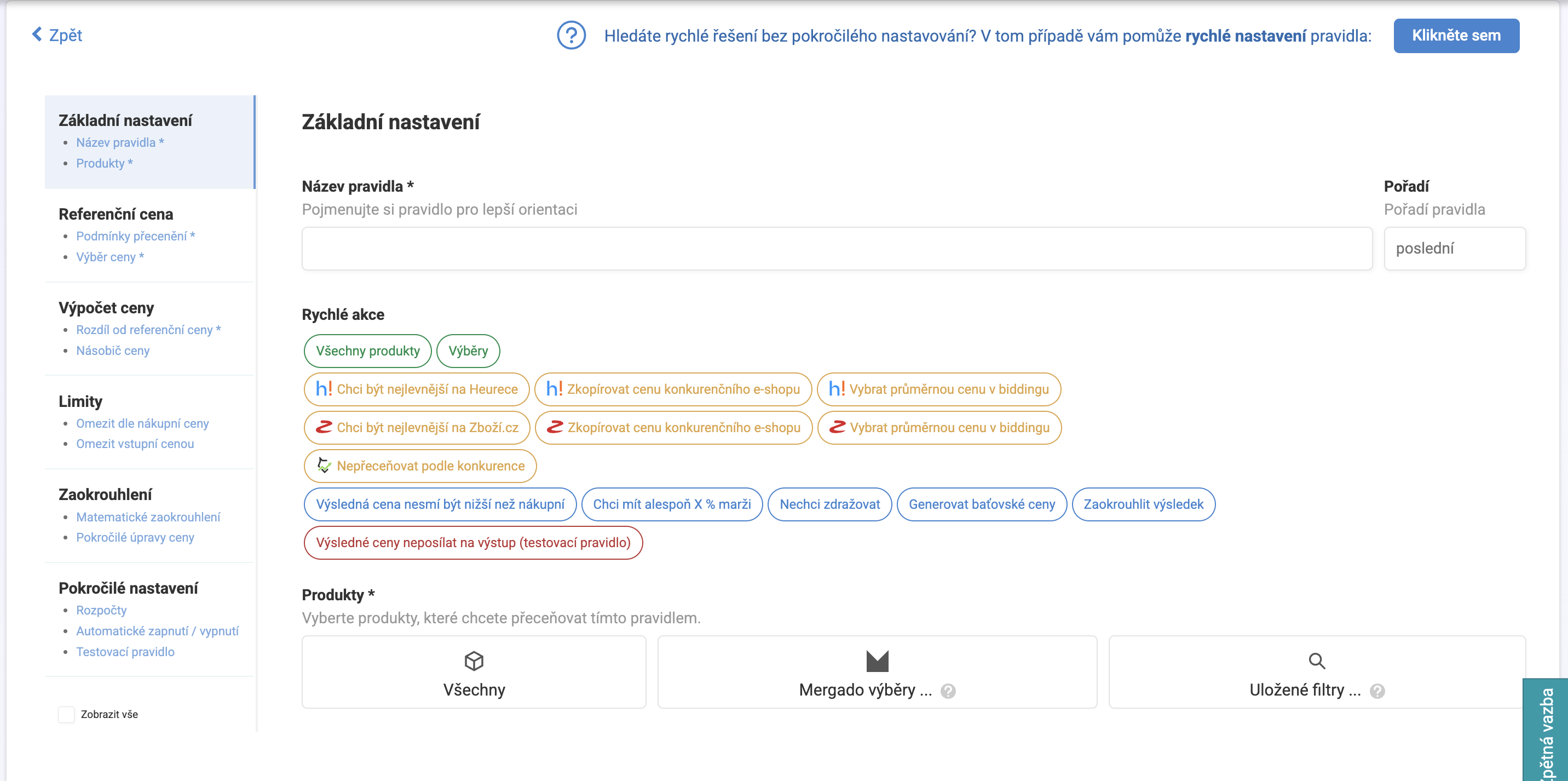
Looking for a quick solution without advanced configuration? Use Quick actions in the Basic settings section – it pre-fills the most-used strategies in three clicks.
Basic settings#
Rule name#
Name the rule for better orientation in the list of rules. The name is internal only – customers don’t see it anywhere.
Order#
Determines the place in the list of rules where the rule is inserted. The order has a direct impact on which rule a product gets – the list is traversed from first to last, and each product is repriced by the first rule it fits into. The default value is last.
Quick actions#
Quick actions pre-fill the most common combinations of settings with one click – handy for a quick start without having to go through all the sections manually.
Product selection:
-
All products – the rule applies to the entire assortment
-
Queries – the rule applies only to products from the selected Mergado queries
Strategies for Heureka:
-
I want to be the cheapest on Heureka
-
Copy a competitor store’s price
-
Choose the average price in bidding
Strategies for Zboží.cz:
-
I want to be the cheapest on Zboží.cz
-
Copy a competitor store’s price
-
Choose the average price in bidding
Other strategies:
-
Don’t reprice according to the competition
-
The resulting price must not be lower than the purchase price
-
I want to have at least X % margin
-
I don’t want to increase prices
-
Generate charm prices
-
Round the result
-
Don’t send the resulting prices to the output (test rule)
Products#
Select the products the rule should apply to. There are three options to choose from:
| Option | Description |
|---|---|
| All | The rule is applied to the entire project assortment |
| Mergado queries | The rule applies only to products from the chosen query in Mergado |
| Saved filters | The rule applies to products matching a filter saved on the Products page |
Reference price#
The reference price is the price from which your product will be repriced – typically the price of a selected competitor or position on a price comparison site.
Repricing conditions#
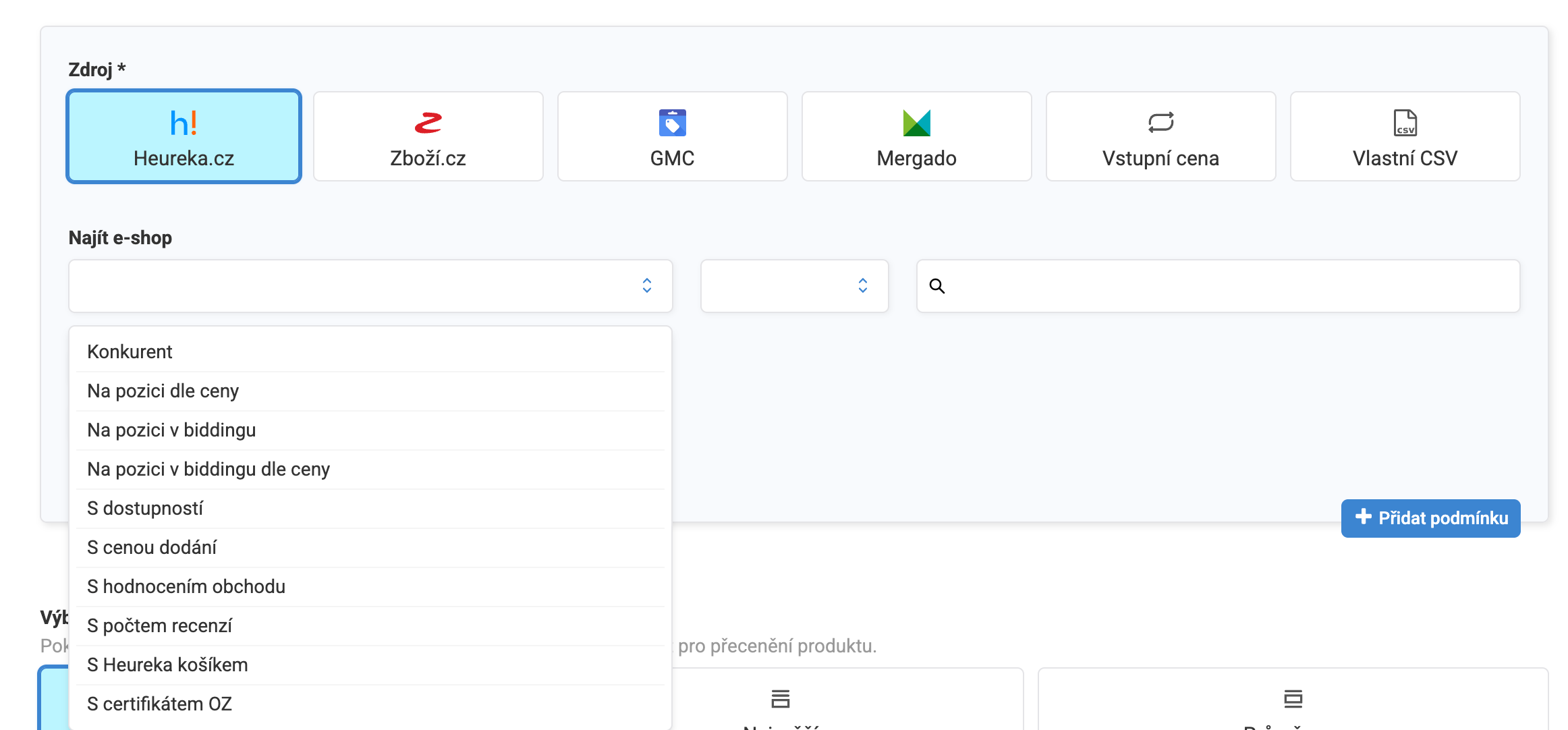
Here you set where and by what criteria Pricing Fox should look for the reference price. You can add multiple conditions with the + Add condition button and combine them using the AND / OR operators – even across different sources.
Source – choose where the reference price should come from:
| Source | Description |
|---|---|
| Heureka.cz | Competitor prices from Heureka.cz |
| Zboží.cz | Competitor prices from Zboží.cz |
| GMC | Prices from Google Merchant Center |
| Mergado | The value of an element from the feed in Mergado |
| Input price | The product’s input price from the feed |
| Custom CSV | A price from an uploaded custom CSV file |
Conditions for Heureka.cz#
After selecting the Heureka.cz source, you can set the Find a store filter – it determines which group of offers the reference price should be taken from:
| Filter | Description |
|---|---|
| Competitor | A specific store by name |
| At a position by price | The store at a certain position in the listing sorted by price |
| At a position in bidding | The store at a certain position in the bidding contest |
| At a position in bidding by price | A combination of bidding position and price order |
| With availability | A filter by the goods’ availability |
| With delivery price | A filter by the amount of shipping |
| With store rating | A filter by the store’s rating |
| With number of reviews | A filter by the number of customer reviews |
| With Heureka cart | Only stores participating in the Heureka cart |
| With the Verified by Customers certificate | Only stores with the Verified by Customers certificate |
You can also tick:
-
Take delivery prices into account – the delivery price is also included in the comparison
-
Restrict by delivery time – filters offers by maximum delivery time
Conditions for Zboží.cz#
| Filter | Description |
|---|---|
| Competitor | A specific store by name |
| At a position by price | The store at a certain position in the listing sorted by price |
| At a position in bidding | The store at a certain position in the bidding contest |
| At a position in bidding by price | A combination of bidding position and price order |
| With availability | A filter by the goods’ availability |
| With delivery price | A filter by the amount of shipping |
| With pickup price | A filter by the price of in-person pickup |
| With store rating | A filter by the store’s rating |
Conditions for GMC (Google Merchant Center)#
When you select the GMC source, you choose the type of price:
| Type of price | Description |
|---|---|
| Suggested price | The price suggested by Google based on Merchant Center data |
| Benchmark price | The product’s benchmark price on the market. |
Reference price selection#
If multiple offers meet the conditions, choose which of them Pricing Fox should use for repricing:
| Option | Description |
|---|---|
| Lowest | Takes the cheapest offer meeting the conditions |
| Highest | Takes the most expensive offer meeting the conditions |
| Average | Calculates the average of all offers meeting the conditions |
No reference price#
Set what Pricing Fox should do with a product for which no offer meets the conditions:
| Option | Description |
|---|---|
| Don’t change the price | The product keeps its current price unchanged |
| At least apply limits and rounding | The price isn’t repriced, but the set limits and rounding are applied |
| Drop through to the next rule | The product continues to the next rule in order |
Price calculation#
Once the reference price is found, this section determines what Pricing Fox does with it – whether it copies it, adjusts it by a given amount, or multiplies it by a coefficient.
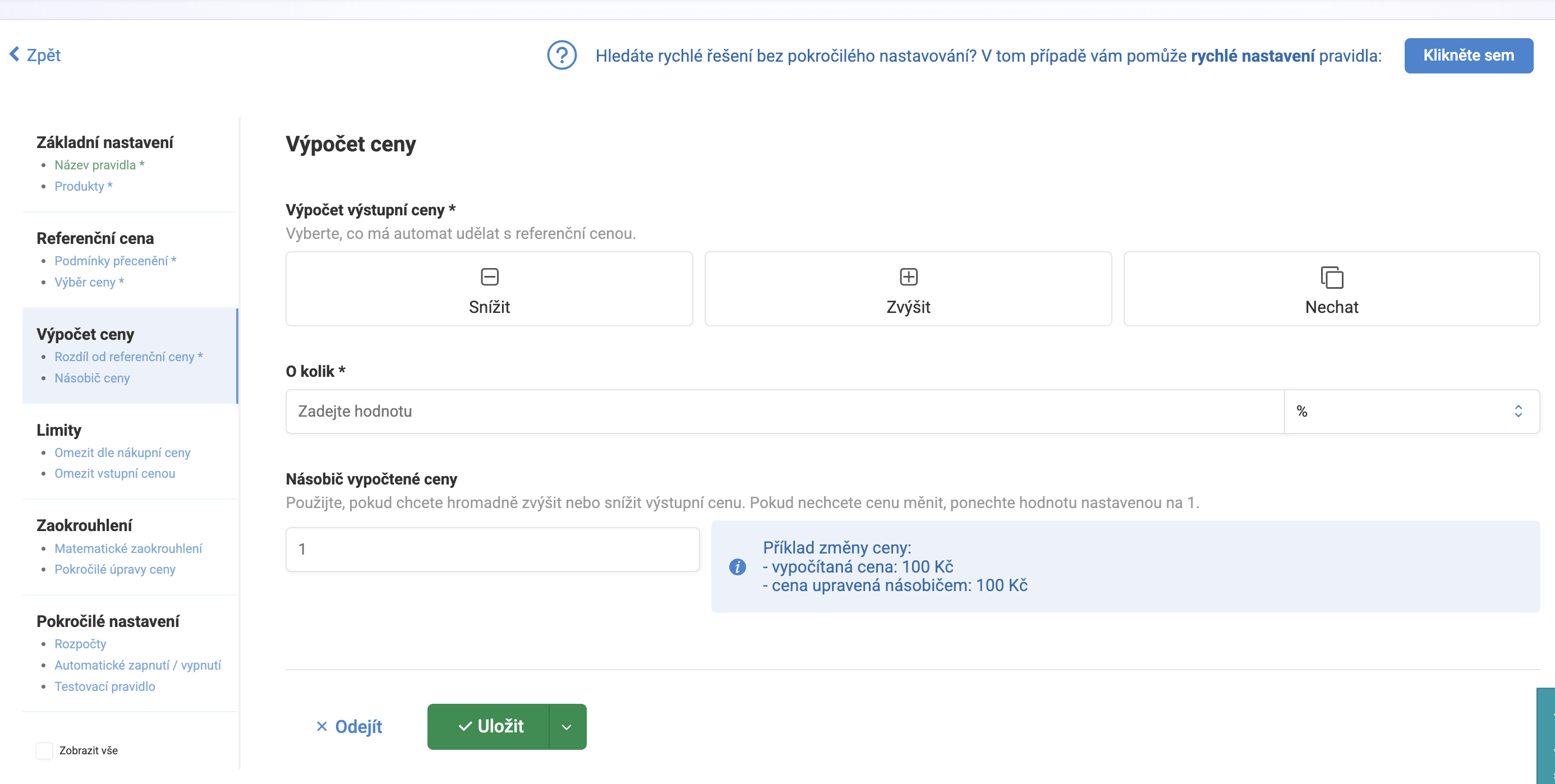
Output price calculation#
Select the operation the engine should perform with the reference price:
| Option | Description |
|---|---|
| Decrease | The resulting price will be lower than the reference by the given amount |
| Increase | The resulting price will be higher than the reference by the given amount |
| Keep | The resulting price will be identical to the reference price |
By how much – enter the difference value. The unit can be switched between % (percent of the reference price) and CZK (an absolute value).
Calculated price multiplier#
An optional coefficient by which the resulting price is multiplied after the previous calculation. It comes in handy, for example, when you need a blanket price increase or decrease across the whole rule. The default value 1 doesn’t change the price.
Limits#
Limits protect against a resulting price that would be too low or too high. They’re always evaluated in this fixed order:
Order of limit evaluation: input price -> purchase price -> markup -> margin -> output price restriction
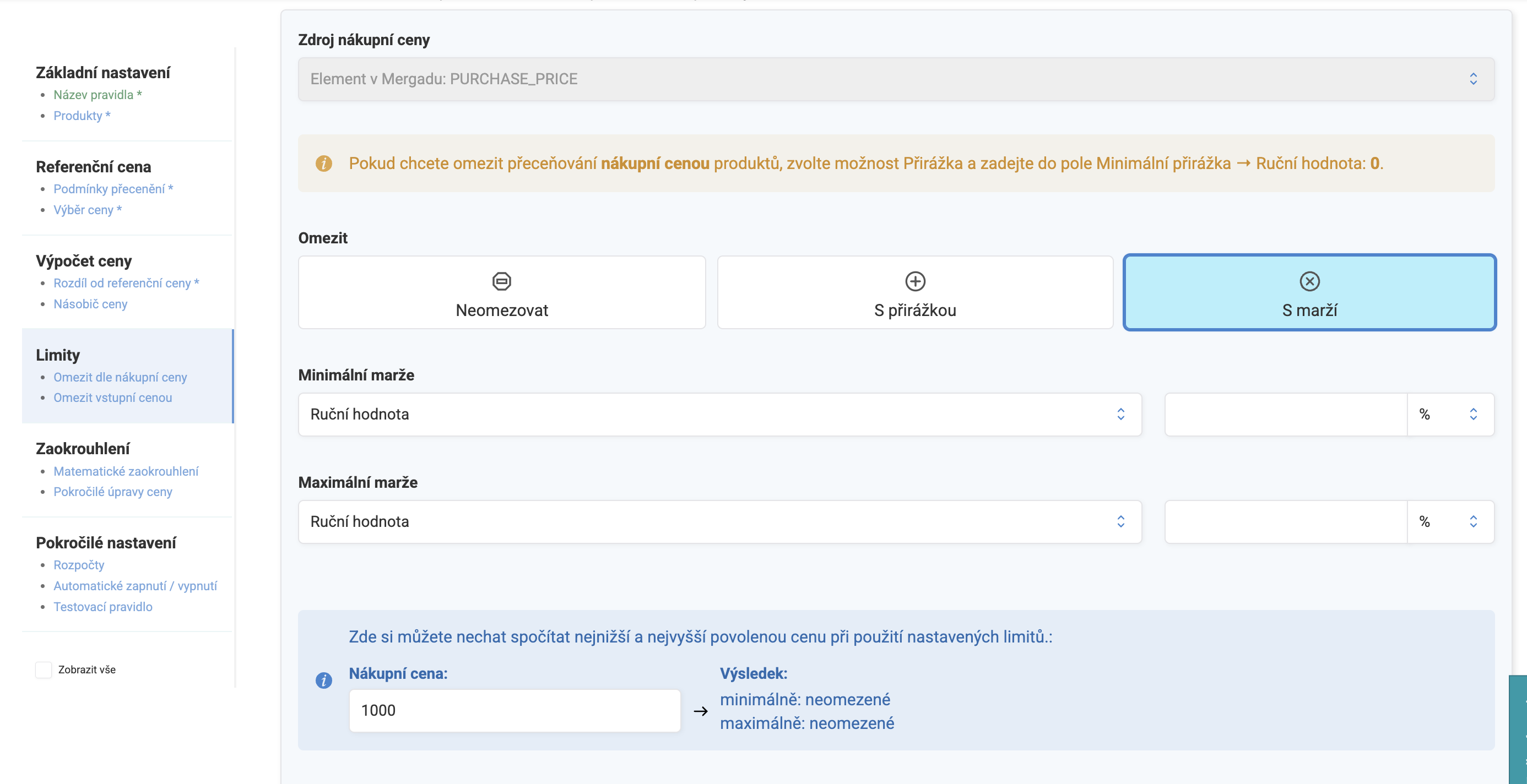
Restrict by purchase price#
Set the minimum and maximum markup or margin calculated from the product’s purchase price.
Source of the purchase price – select the element from the feed in Mergado that contains the purchase price (default: PURCHASE_PRICE).
Restrict – choose the type of limit:
| Option | Description |
|---|---|
| Don’t restrict | No limit from the purchase price |
| With markup | Set a minimum and/or maximum markup in % of the purchase price |
| With margin | Set a minimum and/or maximum margin in % of the sale price |
For both variants (markup and margin) you enter a Minimum and Maximum value. As the source of the value you can select a Manual value (you enter a number manually) or another data element from the feed.
If you want to prevent selling below the purchase price, choose With markup and set Minimum markup -> Manual value: 0.
The built-in calculator shows you the lowest and highest allowed price for a given purchase price and the set limits.
Manual output price restriction#
An absolute price safeguard independent of the purchase price:
| Field | Description |
|---|---|
| Lower threshold | The minimum allowed resulting price in CZK |
| Upper threshold | The maximum allowed resulting price in CZK |
Restrict by input price#
Restricts how much the resulting price can fall or rise compared to the product’s input price. Values can be entered in CZK or in %:
| Field | Description |
|---|---|
| The resulting price decreases by at least | The product must be discounted by at least this amount |
| The resulting price decreases by at most | The product must not be discounted by more than this amount |
| The resulting price increases by at least | The product must be increased by at least this amount |
| The resulting price increases by at most | The product must not be increased by more than this amount |
If the resulting price exceeds the limit#
Set what Pricing Fox should do with a product whose calculated price hits a limit:
| Option | Description |
|---|---|
| Clip the price | The price is clipped to the limit value |
| Drop through to the next rule | The product continues to the next rule in the list |
Rounding#
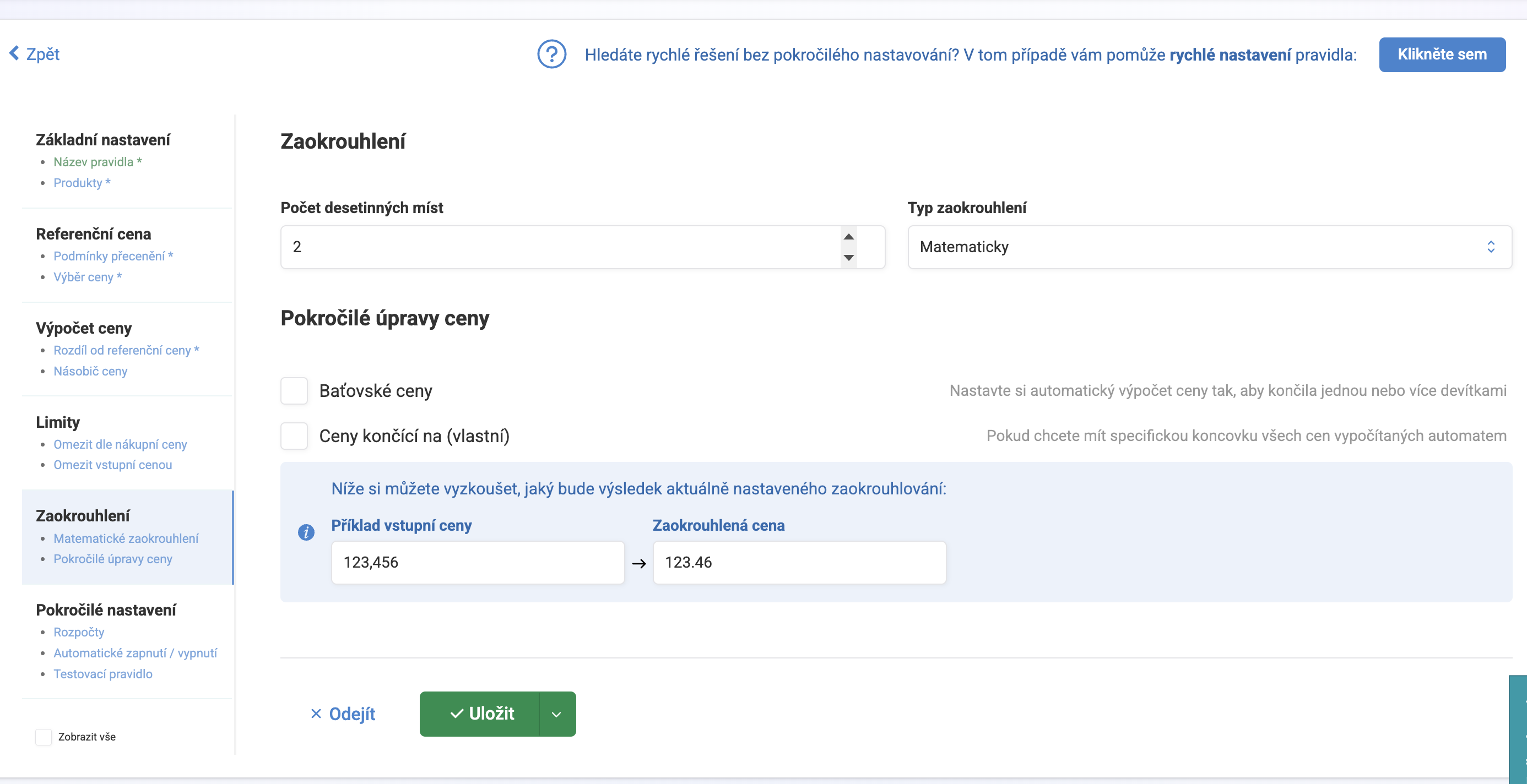
Mathematical rounding#
| Parameter | Description |
|---|---|
| Number of decimal places | The number of digits after the decimal point (default: 2) |
| Type of rounding | The rounding method – e.g. Mathematical, Down, Up |
Advanced price adjustments#
Charm prices – automatically adjusts the resulting price so it ends in one or more nines (e.g. 499 CZK instead of 500 CZK).
| Parameter | Description |
|---|---|
| Number of nines at the end | How many digits at the end should be a nine |
| The resulting price must be | Whether the price after rounding may be more expensive or cheaper than before the adjustment |
Prices ending in (custom) – set any custom ending for the resulting price (e.g. always end in 90).
| Parameter | Description |
|---|---|
| Price ending | The desired ending (e.g. 90, 50) |
| The resulting price must be | Whether the price after the adjustment may be more expensive or cheaper |
The built-in calculator lets you enter an example input price and immediately see what the rounded resulting price will be.
Advanced settings#
Turning the rule off after exceeding the budget#
A rule can be automatically paused if it exceeds a set turnover or cost. You can add multiple budgets with the + Add budget button.
Automatic turning on / off of the rule#
Set when Pricing Fox should automatically start or stop the rule – suitable, for example, for seasonal promotions or time-limited campaigns.
| Mode | Description |
|---|---|
| One-time | The rule turns on / off once at the specified time |
| Repeat | The rule turns on and off repeatedly according to the set schedule |
You enter the Turn on at and Turn off at times.
Test rule#
Ticking this switches the rule into test mode. Pricing Fox calculates the resulting prices but doesn’t send them to the output – instead it saves them into a special field that’s displayed in the app as Test price. Suitable for verifying a rule’s settings without affecting the real prices in your store or on price comparison sites.
FAQ#
Can I combine conditions from different sources in one rule? Yes. Repricing conditions can be combined across sources – for example, look for the price first on Heureka, and if the product isn’t there, use Zboží.cz. Set the OR operator between the conditions to create fallback logic for products that aren’t available on all price comparison sites.
What happens to a product that doesn’t meet any repricing condition? It depends on the setting of the No reference price section – the product either keeps its current price, has only the limits and rounding applied to it, or drops through to the next rule in order. Always set this behavior deliberately to avoid unexpected results.
What’s the difference between the limit by purchase price and the manual output price restriction? The limit by purchase price calculates the markup or margin dynamically from each product’s purchase price – so the resulting limit is different for each product. The manual output price restriction, on the other hand, is a fixed absolute value that applies to all products in the rule.
When should I use the price multiplier? The multiplier comes in handy, for example, when repricing into a different currency (an exchange-rate coefficient), when you need to add a fixed margin above the reference price, or when testing the impact of a blanket price adjustment. If you don’t want to change the price, leave the value at 1.
How does a test rule work and when should I use it? A test rule calculates prices normally but saves them into the Test price field, which is visible only in the app – nothing is sent to the output or to your store. Use it whenever you want to verify a new strategy or limit settings without the risk of changing real prices.
Can I turn the rule off automatically after a promotion ends? Yes. In the Automatic turning on / off section, set the turn-off time and the rule will be paused at exactly the chosen time. For recurring promotions (e.g. every weekend), use the Repeat mode.